WOLF VOSTELL
Betonvagina (Concrete Vagina).
[#21208]
Wolf Vostell, Betonvagina 2 / Die Geburt; one signed photograph and two artist proof screenprints, 1974.
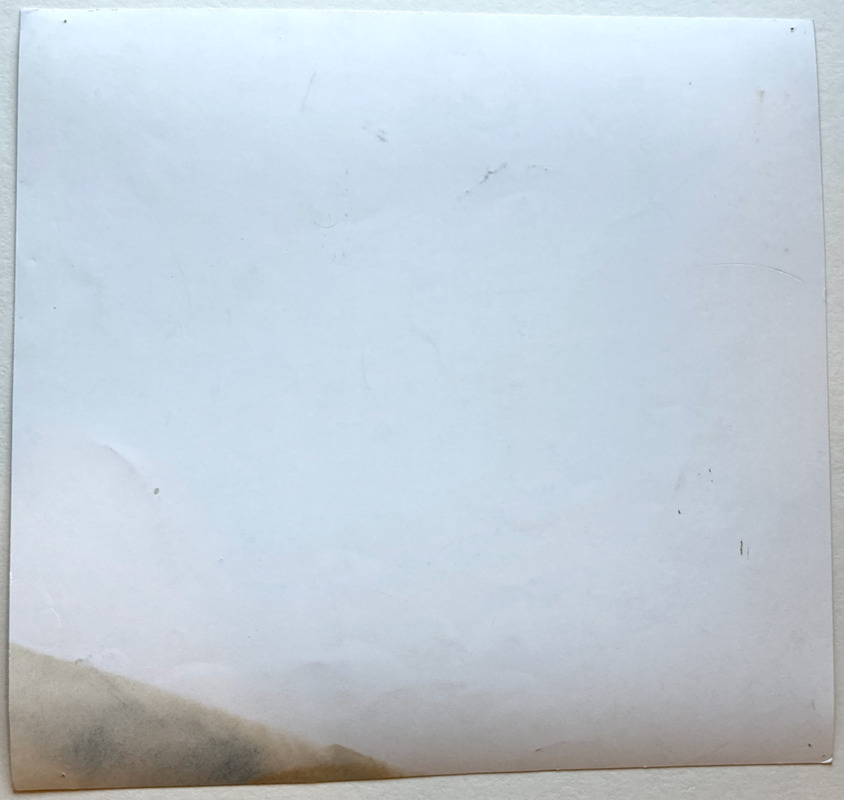
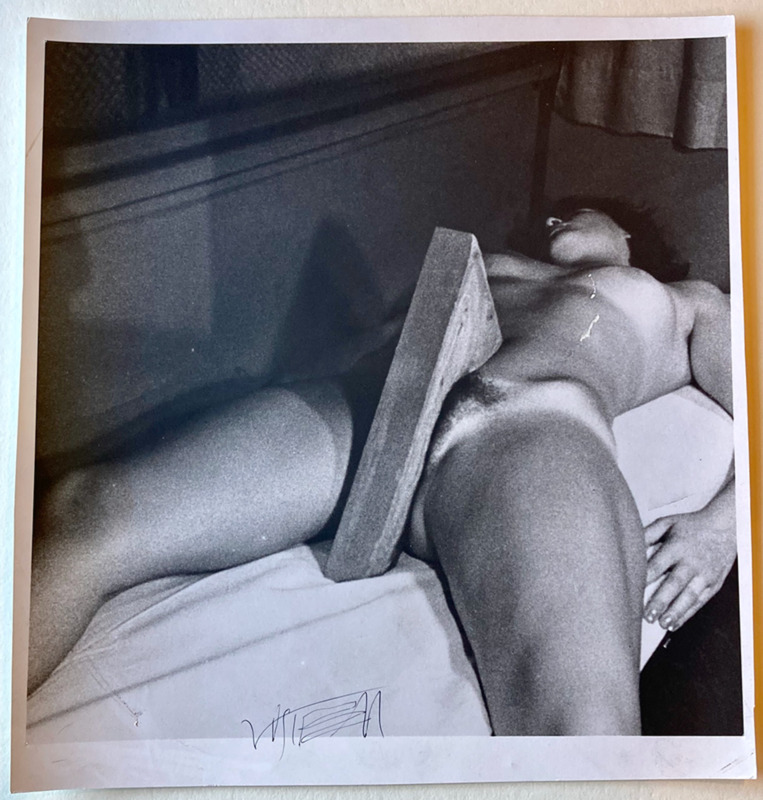
Wolf Vostell, Betonvagina 2, undated (c. 1974). Black and white silver gelatin photograph, 28 x 28.5 cm, with slim white borders, signed by Vostell on the lower margin. The photo features a still image from Vostell’s 16 mm film ‘Desastres’ (1972), produced for the Neuer Berliner Kunstverein’s video art library, which was the first of its kind in the world and co-founded by Vostell. The film incorporates a variety of visual resources: archive material, documentary photos, Vostell’s own concrete sculptures, mixed with surreal scenarios alluding to the brutality and violence in a post-war divided Germany.
This still depicts a ‘betonvagina’ motif (concrete-vagina), used in several works by Vostell, in which he places an angular slab of concrete over the genital zone of a woman lying down with her legs spread apart. By ‘betoniering’ (concreting) various body parts, the artist emphasises the structural violation of the vulnerable body in an almost abstract (concrete) manner. Some surface wear to print, with staining to corner of verso, not showing through, small pinholes to the corners.
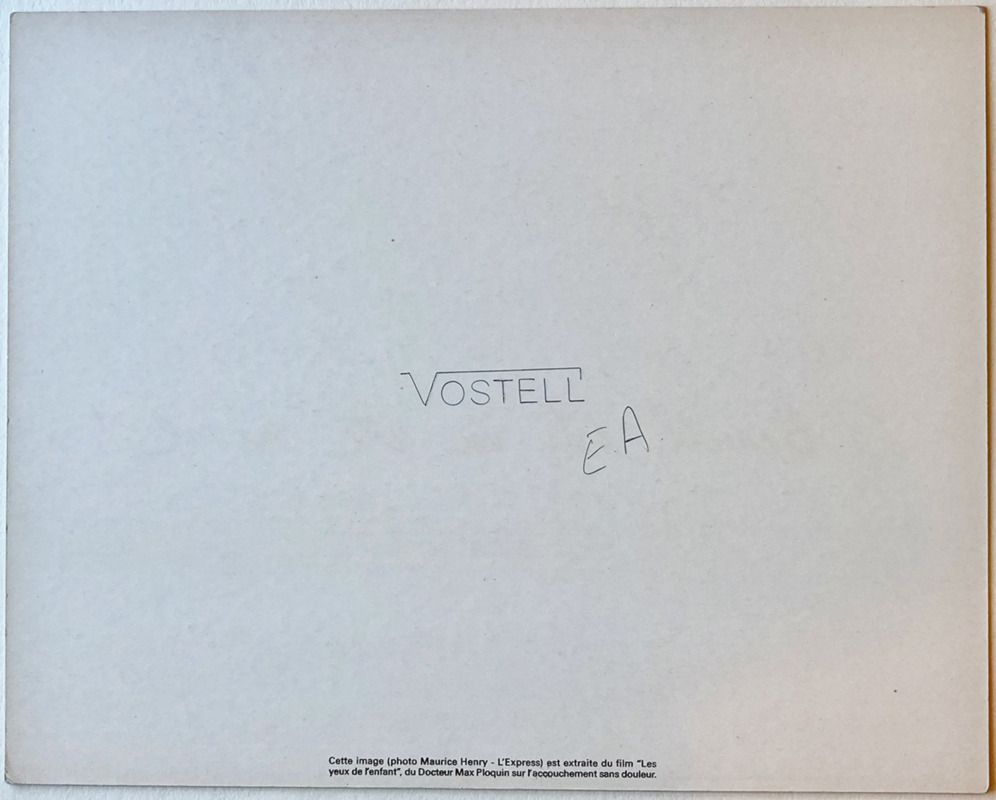
Betonvagina 2 / Die Geburt (The Birth), 1974. Two colur screenprints in black and dark red on thick board, 24 x 30 cm, each with the same heightened dark-red lettering, both identified as artist proofs on verso (EA in pencil next to a printed Vostell logo). The source for the title ‘Betonvagina 2 / Die Geburt’ derives from Wolfgang Vomm, Wolf Vostell: Die Druckgrafik. Bergisch Gladbach, Städtische Galerie Villa Zanders, 2005. p. 120.
The first screenprint,
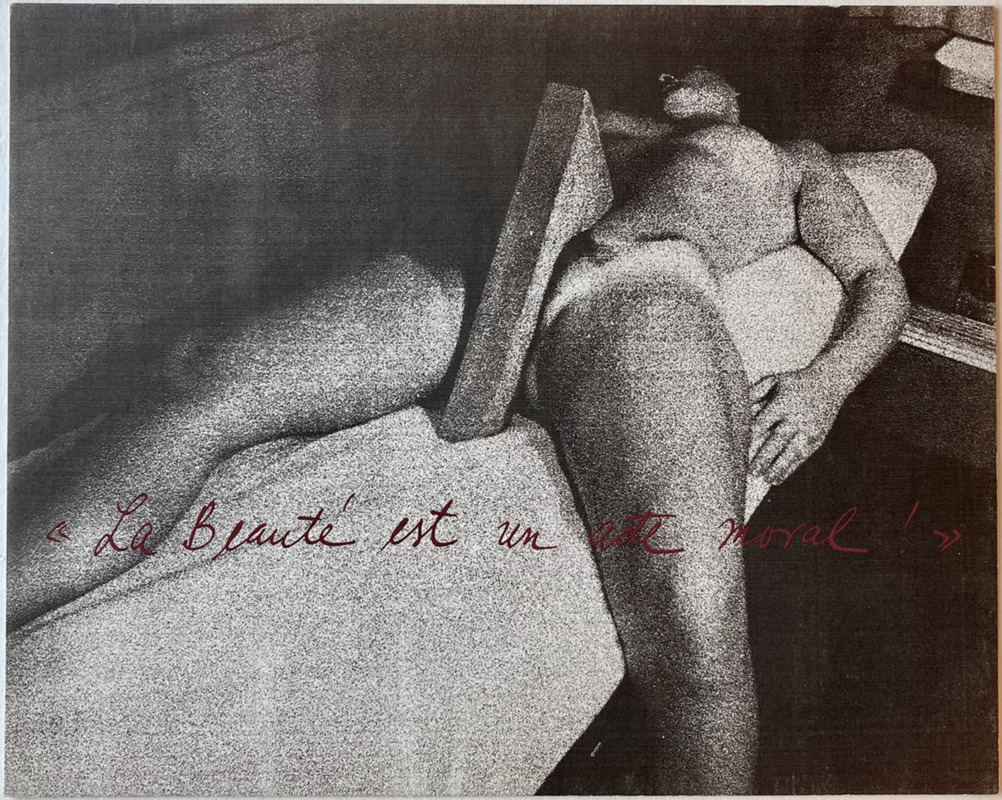
Betonvagina 2, presents a grainy black and white reproduction of the ‘Desastres’ film still identical to the photograph in this group, with a handwritten text ‘La Beauté est un acte moral!’ printed in red suspended over the lower part of the picture. This screenprint was originally produced in a signed and numbered edition of 500 copies for the deluxe edition of the catalogue for Vostell’s exhibition in December 1974 - January 1975 at the A.R.C. 2. Musée d'Art Moderne de la Ville de Paris titled ‘Environnements / Happenings 1958 - 1974’. (Paris, Editions du Chene, 1974).
The second screenprint,
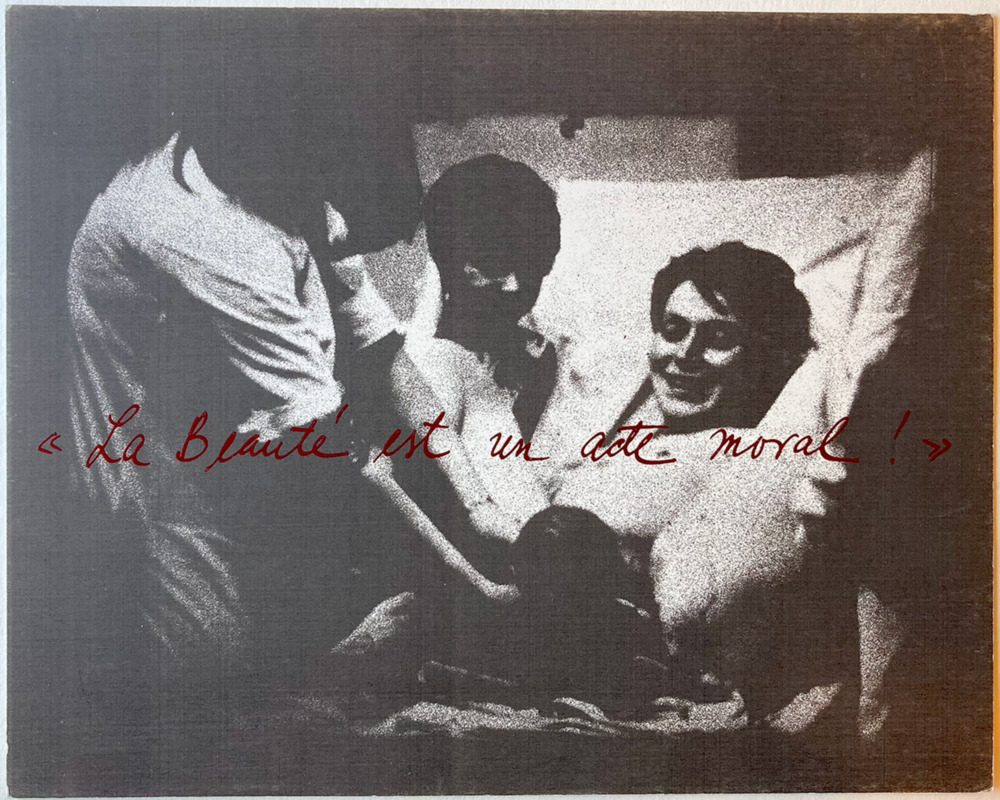
Die Geburt (The Birth), features a different grainy black and white image with the same motto: ‘La Beauté est un acte moral!’. Pictured is a woman giving birth surrounded by a happy family. According to Vomm this serigraphy was probably not published. It does not appear in ‘Desastres’ but seems to be a pendant to the Betonvagina 2 still. The image is sourced from a French film depicting Max Ploquin's experimental ‘pain-free’ childbirth technique (without epidural).
Verso of the print includes the printed caption: ‘Cette image (photo Maurice Henry - L'Express) est extraite du film Les yeux de l enfant, du Docteur Max Ploquin sur l'accouchement sans douleur.’ Both screenprints have minor surface wear, generally in fine condition.
Wolf Vostell (Leverkusen, 1932 – Berlin, 1998). One of the founders of Fluxus, Vostell was an eclectic pioneer engaged with a variety of media. He was among the first artists to adopt video and installation in his practice and the first to include a television within an artwork in 1958. Techniques such as blurring, Dé-coll/age and embedding objects in concrete are characteristic of his work. Destruction and political engagement are recurring themes. Disturbing images, often depicting war horrors, and menacing instruments like saw blades populate Vostell’s work. He mobilized concrete’s ambivalent connotations of permanence and inflexibility, strenght and violence, to engage with the unrelenting presence of violence in postwar society. Vostell reasoned that if art and life are one, violence must have a place in art and the art public cannot be protected from the awareness of this daily threat.
Wolf Vostell, Betonvagina 2, undated (c. 1974). Black and white silver gelatin photograph, 28 x 28.5 cm, with slim white borders, signed by Vostell on the lower margin. The photo features a still image from Vostell’s 16 mm film ‘Desastres’ (1972), produced for the Neuer Berliner Kunstverein’s video art library, which was the first of its kind in the world and co-founded by Vostell. The film incorporates a variety of visual resources: archive material, documentary photos, Vostell’s own concrete sculptures, mixed with surreal scenarios alluding to the brutality and violence in a post-war divided Germany.
This still depicts a ‘betonvagina’ motif (concrete-vagina), used in several works by Vostell, in which he places an angular slab of concrete over the genital zone of a woman lying down with her legs spread apart. By ‘betoniering’ (concreting) various body parts, the artist emphasises the structural violation of the vulnerable body in an almost abstract (concrete) manner. Some surface wear to print, with staining to corner of verso, not showing through, small pinholes to the corners.
Betonvagina 2 / Die Geburt (The Birth), 1974. Two colur screenprints in black and dark red on thick board, 24 x 30 cm, each with the same heightened dark-red lettering, both identified as artist proofs on verso (EA in pencil next to a printed Vostell logo). The source for the title ‘Betonvagina 2 / Die Geburt’ derives from Wolfgang Vomm, Wolf Vostell: Die Druckgrafik. Bergisch Gladbach, Städtische Galerie Villa Zanders, 2005. p. 120.
The first screenprint,
Betonvagina 2, presents a grainy black and white reproduction of the ‘Desastres’ film still identical to the photograph in this group, with a handwritten text ‘La Beauté est un acte moral!’ printed in red suspended over the lower part of the picture. This screenprint was originally produced in a signed and numbered edition of 500 copies for the deluxe edition of the catalogue for Vostell’s exhibition in December 1974 - January 1975 at the A.R.C. 2. Musée d'Art Moderne de la Ville de Paris titled ‘Environnements / Happenings 1958 - 1974’. (Paris, Editions du Chene, 1974).
The second screenprint,
Die Geburt (The Birth), features a different grainy black and white image with the same motto: ‘La Beauté est un acte moral!’. Pictured is a woman giving birth surrounded by a happy family. According to Vomm this serigraphy was probably not published. It does not appear in ‘Desastres’ but seems to be a pendant to the Betonvagina 2 still. The image is sourced from a French film depicting Max Ploquin's experimental ‘pain-free’ childbirth technique (without epidural).
Verso of the print includes the printed caption: ‘Cette image (photo Maurice Henry - L'Express) est extraite du film Les yeux de l enfant, du Docteur Max Ploquin sur l'accouchement sans douleur.’ Both screenprints have minor surface wear, generally in fine condition.
Wolf Vostell (Leverkusen, 1932 – Berlin, 1998). One of the founders of Fluxus, Vostell was an eclectic pioneer engaged with a variety of media. He was among the first artists to adopt video and installation in his practice and the first to include a television within an artwork in 1958. Techniques such as blurring, Dé-coll/age and embedding objects in concrete are characteristic of his work. Destruction and political engagement are recurring themes. Disturbing images, often depicting war horrors, and menacing instruments like saw blades populate Vostell’s work. He mobilized concrete’s ambivalent connotations of permanence and inflexibility, strenght and violence, to engage with the unrelenting presence of violence in postwar society. Vostell reasoned that if art and life are one, violence must have a place in art and the art public cannot be protected from the awareness of this daily threat.
EUR 1,200.00
More images: